Sunday, June 29, 2008

From Both Sides of the Closet Door

At the Gay Pride Parade on May 31, hundreds of homosexual Koreans and expats converged at the Cheonggye Stream in downtown Seoul.

They came together for communion, community and camaraderie - to celebrate their sexuality healthily, out in the open, in the daytime.

For gay and lesbian expats living in Seoul, theirs is a life of relative openness. Many are far from family and friends who might otherwise disapprove - which makes them a little more fortunate than their Korean brothers and sisters.

As a country deeply rooted in Confucian tradition, in Korea there is a heavy focus on carrying on the familial genetic line. When it comes to homosexuality, this is not yet a tolerant society and far from accepting.

Cho Jeong-kwon, a 27-year-old university student, has been active in the gay community for five years but has not told his family he is gay.

"It is very hard to say," he said. "I can't imagine that they accept my sexuality.

"Several times I tried, but it was impossible. I don't like to lose my family because I love them."

Cho finds comfort in the gay community.

"We share a big same secret," he said. "So I think we can understand each other. I feel there is some kind of wall with straight people."

Then there is Hong Seung-chan, a 25-year-old university student, who has been openly gay for four and half years.

Hong said he knew he was gay when he was 13.

"Of course my parents, teachers, friends - nobody had any idea," he said.

He became more independent after high school and began using the internet to find other people like him. Once his mother discovered his on-line activity, their problems began.

Though she objected, he told her he would continue to try and meet other guys.

"She did literally anything to stop me," he said.

"I felt that my life was unreal. I didn't even have a single vague image of what I was going to be. I had to meet someone like who I was, talk about the issue, or have some dates and live a real life."

When Hong got out of the Army he went looking for a gay community. He found Chingusai - the human rights group for gay men. Though he was nervous, he went to their monthly meeting last November.

He felt better when he got home, but made the mistake of leaving fliers from the meeting in his room. His mother found the fliers, and, after he went to another meeting, she realized that he had become a member of the group. She told his father, and his parents threw him out of the house.

He found a place to stay with another Chingusai member and is still enrolled in school.

"There aren't too many things changed," he said. "First, I am in the gay community now, and second, I think I know better where I'm going in my life."

Cho's life is different. His parents are confused about his lack of a heterosexual relationship.

"Always they ask me, 'Why don't you have a girlfriend?' Then I say 'I don't know. I think I am not popular to girls."

Even his friends who know about his sexuality still misunderstand him, he said.

"They don't know what I'm suffering, but I have no choice because the gay community is just my secret life," Cho said, adding that there is a fear that his gay friends will "out" him.

"When I run into my gay friends on the street, if I am with my straight friends I don't say 'hi' to my gay friends."

In the past, gay and lesbian Koreans who have come out to their families have been disowned and forced into "medical treatment" or unwanted marriages.

In 2000, a famous television actor announced he was gay, becoming the first public figure to come out in Korea. The announcement cost him his job and subsequently made it difficult for him to find work. When he told his mother he was gay she suggested they drink poison together.

Eight years later, Hong Seung-chan thinks the older generation still views homosexuality as weird but the younger generation considers it fashionable.

"I still don't think people consider it a real issue," he said.

To him, the biggest problem for a gay man in Korea is staying in the closet.

"I think it's a matter of people living a healthier life," he said. "I want people to believe in themselves and not sacrifice their entire life for others. I know it's very hard to be 'out' in Korean society but if people are willing to push through, all the way out, I think it's absolutely worth it."

Cho disagrees.

"I think if I say I am gay, I fight the whole Korean society."

A Great Movie, A Better Book

"No Country For Old Men"

By Cormac McCarthy

Cormac McCarthy's books are good for Hollywood. The movies win awards and make actors famous. They also make some people a lot of money. McCarthy himself hasn't always had that much money, but that hasn't mattered much to him. He has written books for a long enough time that he has started to make money doing it.

In "No Country For Old Men" Llewelyn Moss learns a lesson about money. He learns that when there's a lot of it lying in the middle of the Texas prairie, it's hard to pass up. It doesn't matter that he stumbles across it after checking out a battlefield littered with dead Mexican drug runners. When you live in a trailer and your wife works at Wal-Mart you don't walk away from a satchel full of cash. No matter how much blood it might have cost. He also learns that big money leads to big trouble.

On the Texas-Mexico border that McCarthy writes about no one hides from the sun and the dust blows hard. There are people working deals in the middle of the night at a level of criminal activity that, as Sheriff Bell says, is "hard to even take its measure." Bell has been working the job in his county for decades and he's seen the intensity of crime climb. He narrates a passage at the beginning of each chapter full of learned experience, trying to explain how he has been able to crawl into his cruiser day after day.

If there is one thing that McCarthy knows, it's voice. Anyone who has spent time in the American West can apply the proper accent and inflection to his sparse character dialogue. The Coen Brothers received a lot of praise and money for their film. They found some good landscapes to shoot - old motels at sunset and the Texas prairie, and the scene where Chigurh kills Carson Wells is already on the syllabus for this semester at film school. But their artistic interpretation didn't require much alchemy. The meat of the story was already there. In fact, it's difficult to understand how they reconciled cutting what they did from an already tight, lean novel.

One of the most common complaints from people who watched the film came from the directors' use of ambiguity. People said they wanted to see how Llewelyn's story played out, or know exactly what Chigurh did with Carla Jean. It gave them a lot to talk about but they didn't want to have to guess. Viewers left the movie with questions that couldn't be answered. The solution to that is simple: Read the book and you won't have to. It's all in there plus some bonuses.

People who loved the movie will find the book by a large degree more enjoyable. There is more narration, more is explained, the characters are more developed - there is just more. We all should have read the novel before we watched the movie, but it doesn't always happen that way. It's not too late, though. There is still a lot of pleasure to be gained from reading. The scene where Llewelyn picks up the girl hitchhiker is worth it alone.

The good that comes from the film industry recognizing McCarthy's talent manifests itself in the form of exposure. Along with Phillip Roth, Don DeLillo and Thomas Pynchon, he has long been considered one of America's great living writers. Of the four, McCarthy is the most deserving of the Nobel Prize. Maybe if they keep making his books into Oscar-winning films, he'll get what he deserves.

Korean Dream Pop

At a club in Gangnam, pop singer Yozoh sauntered on stage wearing black pants, a white button-down shirt, a skinny black tie and a black fedora. Followed out by a violin player, she addressed a responsive crowd warmly and with a fair amount of stage presence. She let the audience sample her voice. She sounded sweet, cute, in line with much of the Korean pop music I have heard.

Initially singing with Sogyumo Acacia Band, Yozoh has released an introductory solo album titled, naturally, "My Name is Yozoh." It is nine songs of soft pop, with Yozoh front and center. The verses are in Korean, the choruses in English. There are a lot of giggles and cutesy vocal tricks thrown in to keep it light. The young, playful spirit of the songs pairs well with Korean kidults. I imagine a young adult couple wearing matching pink sweaters, sharing the ear buds on a Mickey Mouse-shaped mp3 player, walking hand in hand through a Hyundai Department store, listening to Yozoh.

Then comes the blindside. On the song "Banana Party," Yozoh sings, in her breathy, sweet voice, "Give me your banana, let me taste your banana" in a repeated refrain. The double entendre shatters whatever sense of innocence you feel when you first meet her songs. Apparently, the song is on a television advertisement for a digital camera, but it might not get past American censors.

On April 27, as part of a Pastel Records showcase billed as "Mellow Songs About You," Yozoh's label-mates Lucite Tokki joined Han Hui Jeong and Dannawhale at Club SSAM in Hongdae.

The press release for Lucite Tokki begins with "Waiting for music that makes you feel like an innocent child and a mature grown-up at the same time?" Though not as successful as Yozoh (aside from "Banana Party") in that realm, that marketing strategy does fit the generic aesthetic of Lucite Tokki.

Cho Ye-jin sings and Kim Seon-yeong plays guitar - what they don't play, they make up for with electronics. Cho sang with Humming Urban Stereo on two albums and her soft voice blends well with Kim's ethereal guitar parts. The use of electronics to expand the atmosphere of their songs gives Lucite Tokki a dream pop quality.

As far as it goes, there is a lack of singular identity in each of these albums. Both are well-produced and the singers have talent, but I am missing the distinct element that these musicians are advancing their tradition. It is as though they are trying to appeal to too many groups - kids, the young adults, and adults all in one. This might be a smart approach to land on radio and MTV.

However, I would like to see these gifted musicians taking their art form to a higher plane. If they narrow their scope, both Yozoh and Lucite Tokki should be able to carve out a niche and be an asset to the Seoul indie scene. Surely, Seoul has many talented, undiscovered independent bands. I am still looking.

The Sudanese Elephant in the Room

"What is the What: The Autobiography of Valentino Achak Deng"

By Dave Eggers

When he was a young boy, armed Arab horsemen raided Valentino Achak Deng's village in southern Sudan. They burned homes and slaughtered the villagers. He ran for his life and got away from the murahaleen. But escaping did not ensure his safety. Many dangers waited for him out in the African wilderness.

Without any knowledge of his family's safety, he ran until he found others. Hundreds of walking boys banded together, shuffling across the barren plains of southern Sudan. They had little water and less food. These walking boys would later be called the Lost Boys of Sudan. If the sun and heat and lack of water didn't kill the Lost Boys, then there were the lions that stalked them in the grass at night.

Allow a necessary comment on the title: "What is the What" comes from an old Sudanese proverb that said when God made Sudan, he gave the people a choice - they could have the cow, or they could have the What. They were smart enough to choose the cow, but they still wonder about the What.

There is a timeliness to "What is the What." In the book's introduction, Deng states that between May 16, 1983 and Jan. 9, 2005, over 2.5 million people died of war and war-related causes in Sudan. More than 4 million people were internally displaced in southern Sudan and nearly 2 million southern Sudanese took refuge in foreign countries - atrocities that have occurred while we have been alive. This is the story of a boy who suffered these atrocities, as told to Dave Eggers, who then formed it into a novel.

Eggers deserves the reverence he is held in by literate youth. The memoir "A Heartbreaking Work of Staggering Genius" is the kind of book that people rarely speak badly of, and in the rare instances they do, they are sharply rebuffed by its defenders. His collection of short stories, "How We Are Hungry," is the kind of book people send across oceans to surprise their friends with as a gift. "What is the What" is the kind of book that made a friend of mine start thinking about becoming an aid worker in Africa.

Together, Eggers and Deng traveled to Sudan and spent many days talking about Deng's life. The novel is written from Deng's point of view, but the narrative is crafted with Eggers' attention to detail and instinct for drama. The resulting novel speaks of a refugee's life in Sudan in clear, imaginable language. It is not merely a boy talking about his life; it is a man telling the story of a horrific childhood to an accomplished, gifted writer.

You can hear the lions roar in the night, feel the ache of thirst in the boys' throats, and sense the fear of crossing a river full of crocodiles while being shot at and unable to swim. If Deng had written the story himself, it would have been good material. If Eggers had constructed a similar story from his imagination, it would have been written well. But bringing together a great writer and a story so rich in substance makes it superior.

If you have a conscience, you will read Deng's story with guilt and sadness. But it is not the intention of the author or the subject to invoke pity. The story is not a heartbreaking work of tragedy. The story is not a heartbreaking work of staggering beauty. The story is not a heartbreaking work of the forces of good winning out over the forces of evil. There is no great moral or resolution. It is simply the story of a life that was not simple at all.

The Dark Side of the Road


"The Road"

By Cormac McCarthy

In Cormac McCarthy's masterpiece "The Road," the earth has undergone an unnamed disaster that has left the ground scorched and covered in ash. The rivers and oceans are ruined with contamination. When it snows, the trees, weakened by fire, splinter and fall to the ground.

There are survivors and they live in desperate terror. A father and his son are of the few left alive.

McCarthy never explains the cause of the condition of the world. In fact, there is little back-story given at all.

In a rare flashback sequence, the reader learns the wife and mother of the men survived the devastation but could not bear the aftermath. The fear of living in a world of civilization reverted to barbarian savagery proved too much. She took her own life rather than face what was left.

So then it is just the man and his son left on the road and they are headed to the coast.

McCarthy is one of the best American writers we have. His body of work owes much to William Faulkner. But where Faulkner wrote of the South, much of McCarthy's work is set in the American West.

Some have speculated that "The Road" happens in the southeastern United States, that the pair traverses the Great Smoky Mountains to reach the ocean. This is possible. The Smokies are aptly named -- cloudy hills covered in trees that rise just west of the Atlantic Ocean, which matches the setting of the novel.

Regardless, McCarthy has become masterful in his writing. The narrative is a fragmented mosaic of well-wrought scenes. McCarthy said he wrote the book for his son, and that is where the essential value of the story lies.

Often the two have no food or shelter as they push a shopping cart full of their meager belongings across the wasteland. They encounter gruesome scenes of cannibalism that shake the boy's faith. He sometimes goes silent, but the father coaxes him back, reminding him that they are the good guys, that they "carry the fire."

As in Alfonso Cuaron's film "Children of Men," the story is of a dystopian future. Like those in the film chasing the last fertile woman on earth, gangs of men and women have banded together to prey on the remaining survivors.

To avoid becoming food the father and son sleep in the forest, under bridges, and in abandoned houses. They carry a pistol with two bullets left in the chamber, one for each of them lest they are caught.

Despite the bleak undertones they hold out hope that when they get to the coast there will be good people there. On their way they must be vigilant and always watch behind them.

Huddled and black-cloaked men and women shuffle down the road. They are surrounded on all sides by white and gray trees. Gray-white hills roll under the path and trees. It is dark, stark and cold.

If it seems as though this review is heavy on the coloring of McCarthy's landscape, that is because the sense of place is remarkably well-crafted and artfully performed. He weaves the feeling of this ravaged world into the characters without long, descriptive exposition.

Rather, he writes in clean, stripped-down prose, knowing that the most effective writing is simple writing. What matters most is how fully-realized the novel is and "The Road" is rich in detail and character.

From the onset of the novel the world smolders and smokes. You can smell the oil and wood burning. You see it through the eyes of the son and hear it in the warnings from the father.

The love the father has for his son peers dimly out into all this darkness. The boy, who might be around 8 years old, starves sometimes, growing so thin his skin becomes translucent.

Even in the grip of their desperation the father continues to instruct him, as well as protect him from the horrors they see on the road.

In the beginning of the book he reminds him that you forget the things you want to remember and cannot forget the things you wish you could. They encounter a lot they wish they could forget.

But somehow, and this is the great feat of the novel, McCarthy leaves the reader hopeful. There is not a clean resolution -- a story like this would be cheapened by one -- but in the end there is a little good in the vast sea of evil.

Tuesday, May 06, 2008

Five Pictures of Japan


Tuesday, February 19, 2008

The English Teacher


Some time ago he had found himself. He had found himself in Europe or Australia or North America. He had found himself in debt, or without a job, or working for a corporation, or without ever having been anywhere, really. He had found himself with exceedingly fewer outs. If “himself” was a place, then he wanted to move.


It was then he remembered: he knew someone who had taught in Korea. The person he knew of took vacations in exotic places and told good stories about those places.

So he took an airplane a long way trusting e-mails rife with bad English. He landed in Seoul in the dark and the first images he noticed were the red neon crosses. From the window he watched them float in the night as he took a bus to Jeonju or Cheonju, or Gwangju or Gyeongju.

He started work the next day and the work was good. They did things differently, that’s for sure, but they were nice to him even if they didn’t always pay him on time. The children made him feel happy in the morning and then feel tired in the afternoon.

His apartment was small. It had bugs. But he didn’t mind. He wouldn’t spend that much time in it anyway. There were a lot of things to do in his new place. He wanted to find friends, the good restaurants, good places to see music. A friend told him before he came to “carve out his niche.” He wanted to do that.

He knew of web sites dedicated to foreigners living in his city. At first that didn’t interest him much—he said he wasn’t in Korea for the foreigners. But after a few months of singing the alphabet song he went looking for a place to have a good talk.

When he got to the bar they were playing the best songs from three years ago. It was easy to meet people—most of the crowd liked talking about themselves. “Why in God’s name did you come to Korea?” they asked him. They asked him because they had come with as much reason as he did. It had seemed as good of a place as any.

The people he met were what they were or what they aren’t. They were not in Korea for the air. They were not in Korea for the beaches. They were not in Korea for the architecture. They came from places with great natural beauty. They came from places where a person can be alone in that great natural beauty. He wasn’t sure why they were there.

Some seemed to make more sense than others. They were the teachers in their homeland that thought teaching in Asia sounded exotic. Or they wanted to be teachers when they returned but were prolonging that commitment. Most said they were not teachers.

Some thought of themselves as travelers. They took weeklong vacations to Southeast Asia and brought back a t-shirt from each country. They went to Japan and China and talked about the magic they had witnessed.

Some had been there too long. They had been running from a life that was chasing them with a morbid inevitability and they had run too far. They were lonely; they made new friends but those friends didn’t stay. Most were something else in their homeland that either hadn’t happened or wouldn’t. They felt detached from their old scene and their old friends and their old culture. But they didn’t want that back, or this, exactly—they somehow wanted both and neither.

In time, he quit the bar. He had met people and learned about the world, but still they were not his people. He knew his time in Korea was meant to be short, and even though he had stayed longer than he thought he would, it seemed futile to develop short-term friendships. His time was almost up and he didn’t think he would ever come back.

Once again he found himself. He found himself alone in a country of an ancient race. He found himself at the end of a year (or was it two?) in a foreign country. He found himself with no desire to go home, yet without desire to stay and attempt to assimilate into an impenetrable culture. He was leaving; it was time. He was going somewhere. But he didn’t know where.

Thursday, January 10, 2008

The Boy Before School


The city woke up crying. I walked out to the clamor. Down the street men on scooters stopped to unload food then disappear into buildings. Children wearing uniforms under backpacks walked into computer rooms. The great apartment across the street was waking up. Trucks backed to the ground floor furniture store. People came down from their cells, walking through the aisles of new beds and tables to shop under the fluorescent lights of the adjacent grocery store. The rented world was awake.


I sat on the ledge of our landing writing report cards when the boy came over. He wore a brown, hooded-coat with the fur-lined hood up over his black hair. He looked at me with large, black eyes. His eyes were remarkable. In every other way he looked like an average Korean boy.


I said hello and smiled. Although he could not have stood closer without standing upon me he did not acknowledge my greeting. When I said hello again, this time in Korean, I received the same stare. He just stared, inches from my face, with those big black eyes.


“What’s your name?” I said.
He leaned in closer to look at the letters I was placing together on the paper on my lap.

“Irumun buot iyaeyo?”


No use. He wasn’t going to disrupt his role as detached observer to offer a word, in any language.
I wrote: Kristy is improving. Her reading and speaking skills are getting better everyday. We need to work on her pronunciation but overall she is a great student. I enjoy having her in my class.

He reached across my lap to touch the hand I wrote with and the beads on my wrist. I feared he might begin to pet me. But no matter how awkward it got I wasn’t going to be pushed from my seat, or my work, by a 10-year-old boy. The report cards were due by the beginning of school and I had these minutes before the bus came, then the quick ride to finish them. So I sat my ground, writing—-all the while under the scrutiny of this silent boy, his face inches from mine.


There are those in Eastern thought that believe silence is a form of conversation. If that is true then we were getting to the bottom of many things. I wasn’t making the best eye contact, and wasn’t sure how good of listening skills I displayed as I sat there scrawling, but the boy was intent on our interaction. He seemed to speak passionately about something that didn’t need verbalized.


Karina came out to wait with me. Although she dresses far more interestingly, and is quite prettier than I am, she did not take the boy’s interest. “I’ve made a friend,” I told her as she sat down. I looked up and smiled at the boy. He continued to stare.


The white van stopped and the door opened. I had a sense that the boy was there for some purpose but I could not uncover it. It was cold. I told him goodbye, that I would wait in the van where it was warm. Still he said nothing. Still he looked at me with those eyes. In time the other teachers came. Before we drove off I looked for him. He was standing on the sidewalk, watching me leave.

Saturday, December 01, 2007

Dreamland

“Describe a cube," she said. "A cube in the desert.”

“Okay…all right," I said. "The cube is heavy and dense. It’s made out of basalt. It’s seven by seven by seven. It’s black and it’s wedged into the sand, like buried halfway up, like it fell from the sky.”

“Good. Okay, now, describe a ladder.”

“Right. All right, the cube is in the foreground, the ladder is in the middle ground, and it’s a steel step-ladder, tall enough to perfectly frame the cube if you look at it right, from far enough away…the cube sits in the triangle it makes?”

“Okay. Now, a horse.”

“All right, it’s a palomino. It’s off in the distance on the horizon and it’s walking away. It’s a spec of dust. It’s too far away to hear you. You can’t call to it—-it won’t save you.”

“Okay…that’s it. That’s good.” She smiled and looked at the space around our feet. “Now do you want to hear what they mean?”

“I knew it. I knew this ‘meant’ something. That’s why I didn’t want to do it.”

“Well, the cube is good. It’s you—-what you think about yourself. The ladder is your family. And the horse,” she laughed, “the horse is love.”

“I told you what I think about that.”

“I know you did.”

We were sitting on wood benches under a canopy of overgrown vines draped over the edges. She sat across from me; we weren’t touching.

~~~

It must have been good once. We had left her apartment for a walk and saw a sign hanging over the center of the street—-Dreamland—-and followed it. We followed the signs for miles. As we walked we talked about the possibilities—-with a name like that—-for greatness.

“I bet the whole place is one giant cloud.”

“Isn’t this the same as heaven? Isn’t that what heaven’s supposed to be—-dreamland? Are we going to heaven?”

We walked up the sidewalk, past heaps of piled up trash on the street corners, under ginko biloba trees, smelling the grilled beef galbi restaurants, until we saw the gates at the end of the street.

Before the entrance a parking lot—-in the parking lot two cars. Inside the gate we came upon a place, frozen. In the air the still echoes of a once happy park. A spot where families would come with full vans, where the children would—-not hearing their parents’ words of waiting—-leap from the car and run to stand in lines. Where those same children would remind themselves to brag to their friends at school on Monday. Now, the muffled noises of unseen children, now, the faint sounds the whispers of wishes.

An Italian carousel spun for a boy. He sat in a teacup, with his knees wrapped around the center wheel, tongue out of the corner of his mouth, bent in determination, hands working to make the cup spin. No workers, no people—-only the spinning boy.

We held hands. We gave the carousel a wide berth and on the other side found an arcade. Most of the games were turned on and in the corner a man and his son played a gun game. They stopped laughing when they saw us. The park led us past the closed doors of an aquarium, where the paint on a killer whale flaked under the white spot, giving him a grey eye. We walked past a cage of tom turkeys and baboons. The turkeys didn’t recognize us but the baboons clung to the face of the cage and followed us with their eyes.

“This would be a good place to shoot a horror movie.”

On one edge a small forest. We opened a short wooden gate. An overgrown path led us up and out of the concrete. At the end of the path a lone tree lay felled, dead, in a clearing. For a moment we felt as though we were alone in nature—-surrounded on all sides by grass and bushes and magpies talking in the tops of the trees.

We walked in circles around the dead tree. It was here she started talking about the cube. We still had time left on our tickets, so we went on to the back of the park, where we passed a family that would not look at us. We stopped to look at the mural painted behind one of the rides. It had likenesses of famous American musicians and some men and women painted badly enough to appear monstrous. Maybe the bad painting scared the people away. But no, that wasn’t it. At the place where we sat and talked a yellow and red spider waited in the center of a web. It had a warrior face painted on its back.

~~~

The mosquitoes that the spider couldn’t catch drove us out. We took another way back, to the center, where we walked into the blue glow of an empty swimming pool. It stretched away from our feet. It would have been good for skateboards—-long rides to the end.

“I like the color.”

I smelled decaying suntan lotion and heard murmurs of splashing, of children’s feet running through, though their parents had told them not to. I saw a game where they dropped a baekwon in the deep end and dove for it. We left the pool and walked down a grass hill to the gate.

“Do you want to hear mine?”

“Sure.”

“Mine was a Rubik’s cube, unsolved. The ladder was a wooden ladder, laying in the sand, and my horse, my horse was great. It was a pink pony prancing.”

Monday, November 05, 2007

Spirits In the Moonlight

I woke to the sound of drums in the temple yard. I dressed and stepped down from the door of my room onto the grounds. There were nine buildings in the temple yard, all with the sloping, tiled roofs of the Orient. It was cold and still and the sky clear and black. My friend and I pointed out constellations, speaking in low-voices to preserve the calm. Our breath came out in warm vapors and a mist rose from the ground all across the yard. Ahead of us two monks walked slowly in single file, both in robes and shaved heads, and the lead monk carried a small wooden drum, singing an old song that came from deep in his body. The fog, the way they walked, and their robes flowing over the ground gave them the impression of floating. They were spirits awoken in the moonlight.

The monks disappeared into the largest temple. We heard a sharp signal from inside and then, across the yard, three more took up the song. One stood in front of a drum and began a soft tapping that escalated into a tribal march, where he was using the short sticks in his hand heavy and hard against the center of the large drum. Then the song was taken up by one standing under a wooden dragon, where he too held short sticks that he used inside the dragon's belly. And then the bell. In my travels of Korea I have often seen these bells and occasionally heard them rung, but never in the still of deep night. Never only feet away. Never felt the vibrations move the water in my body.

When the drumming stopped we entered the temple and bowed repeatedly to three gold Buddha statues. We joined a dozen or so monks and would kneel, then put our heads to the floor with our palms up, then up to our knees, then in a standing position with our palms together, then back down again. The monks sang in voices immeasurably old. Songs about salvation and torment, about elevation from pain and release from struggle.

After the worship, Muchin, a leader, invited us to sit in an open-air temple. It was black and cold. He told us he was a Zen master and instructed us in meditation. When the lesson was finished he took us to a room and gave us both gifts of tea grown across the river from the temple. He told us it is important to remember that life will rise and fall, and that when it is good and high, to remember to be polite and kind, because it will fall, and then we will need help.

Then we left him and walked into the forest. Autumn had come to give color to the trees. We walked a mile along a stream, breathing in the air. The hike was good in the cold air. By the time we returned to the temple we were warm and the sun shone over the mountain. The temple was holding a photography contest. In order to preserve our calm, we quickly packed up as a group of fan dancers introduced the contest.


Monday, October 08, 2007

The Table is the Plate

Bondaegi (Butterfly larvae)

I have been hiking in the surrounding mountains all day and I am hungry. I find a good clean restaurant. Inside, I spread out the mats on the wood floor and sit down cross-legged at the knee-high table. I open the wooden box and take out a silver spoon and chopsticks.

I order dolsat bibimbap. Before the main course comes, the woman brings me a warm wet towel to wipe my hands and neck and sets out the side dishes. The side dishes, or banchan, are numerous and varied—-of course there is the red, fermented-cabbage kimchi, but beyond that I sample from mackerel cooked but left intact, fried tofu squares, and vegetables covered in red pepper paste or sesame oil.

My food comes in a hot black stone pot. A raw egg rests in the middle of sliced mushrooms, dried seaweed, chopped zucchini, soybean sprouts, and white radish—-all atop a mound of rice. The woman makes the motion of stirring and I comply. The hot pot cooks the egg and I add a little red pepper paste for spice.

I chose the bibimbap not so much for the taste—-I think other Korean dishes taste better—-but for the way it makes me feel. That’s something I find often in Korean food. Many of the meals are energizing rather than crippling. They’re light-—based around vegetables and broths, and some incorporate ginseng as an ingredient, which is a natural stimulant.

Sam gye tang comes in a similar pot. It’s a game hen, or “young chicken,” boiled with dates, rice, ginseng and chestnuts. Koreans traditionally eat it on the hottest day of the year. Compared to Westerners, their logic works in reverse. Where an American would reach for a banana split in mid-July, they actually make themselves hotter to lessen the severity of the outside temperature. This is like chicken noodle soup or menudo-—intended to make you feel better. If you’re already feeling good than you win again.

Koreans eat a lot of meat. They go heavy on pork and beef, but also eat chicken, fish, and have many restaurants that specialize in duck. Males occasionally bond over dog, but it’s difficult to find an admitted dog eater. In my eleven months I have yet to see a dog restaurant. I have eaten American beef twice since Korea lifted the import ban, and both times found it superior in quality to its Australian counterpart.

On the coast, along the harbors and on the piers, raw seafood restaurants abound. A few weeks ago, I met friends in Sokcho, a city on the East Sea. We walked under awnings past large round tubs of swimming sea life—-crab, shellfish, sea anemone, and many types of fish I am not familiar with—-basically whatever they can net. We watched as a woman hoisted an alive, two-and one-half-foot octopus out of a tub, turned its head inside out and tore out its ink bag. We ate three types of fish and a squid that was so fresh it still had life in its suckers.

The most enjoyable aspect of eating in Korea is the experience of shared food. We sit around the same grill built into the center of the table, with everyone adding meat or vegetables as they see fit. We dip our chopsticks into the banchan if we’re bored with the main course. Often we don’t even have our own plates. The table is the plate.

Wednesday, September 26, 2007

Five pictures of Gangwando


Dusk

Harvest

North Korea

Into North Korea

Peace

Tuesday, August 14, 2007

Seoul Glows In Technicolor Korean Neon


Seoul is the epicenter of all culture Korean. The people of South Korea need fed and watered and they go to Seoul for the best their country offers. They demand satisfaction in bars, shopping, and restaurants. And their needs are met.
On the weekends traffic stacks back kilometers before the city limits even begin. The culturally rich city calls in the crowds.

Looking out from the Seoul Tower in the daytime, the city maps out like most of the major cities we see in our lives. Landmark buildings, a downtown district, and a river runs through it. But look closer. There are worse evils than tract housing. This city sprawls away from the downtown skyscrapers into districts and housing like other cities. Yet where others might spread out into housing developments Seoul stands tall. In place of gated communities colonies of high-rise apartment buildings stretch on forever, out beyond the city limits.

Along the Han River, like many Korean rivers, white herons stand in sandbars. Legions of orange dragonflies hunt mosquitoes—-flying, diving through the grass, hovering like helicopters. The surrounding mountains are green, verdurous, and at their foothills rice grows knee-high. Eventually, we turn and look to the north but we can’t see very far. Gray fog veils the border, where beyond a country skulks condemned for its secrecy and suppression.

At night, red crosses burn among the apartment lights. They float in the darkness—-a gang of kinsfolk with raised fire marching to torch a house of heathens. They seem to always face you, with more behind them in the distance and on the horizon, the Lord’s cavalry. These red neon crosses raised my first question when I came to Seoul nine months ago. I soon found out they signified Christian churches and sit at the top of steeples, lighting the way for wayward sinners, driving out the dark.

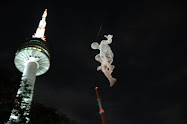
Scanning the nighttime city from the banks of the Han, neon grids trace building edges in pink, green, and blue. Low clouds obscure the tip of the Seoul Tower and the cyclopean light glows white gray. Around it clouds drift and swirl then suddenly the red and white spire succumbs to the Korean Neon. It climbs the tower flashing purple and green and the panoramic restaurant halfway up switches on into a spinning carousel of circus lights. Below it on the edge of the river we watch the lights on the bridges slow-fade change in the colors of the rainbow. The murky water turns royal blue, then blood red, and the current carries on.

Friends call from a bar in Itaewon, the district near the American military base. Walking up the hill we pass two boys, not older than 20, shuffling back to base. “You have to remember to cherish every day,” one says, dead serious, looking at the sidewalk. They disappear. At the top of the hill our friends are out in the street in a crowd of foreigners. Through the windows of a bar a crew-cut boy dances shirtless with another boy. People yell and jump and break glass. Everyone’s trying to live a life in one night.

A missionary for an organization called Kingdom Builders hands me a flyer with Bible verses and a paragraph that reads: “As you take this paper tonight, stop and look around you. How many people are running into places that lead to destruction?”

We drive out of there, tuning into the base radio station and it’s American Country Countdown, counting down America’s greatest hits. We listen to the strange canned country music and public service announcements with hotline numbers for victims of sexual assault. The shirtless boy runs through the sidewalk crowd back down the hill, racing against his curfew. It is late but the city will stay up. Those tired of bars will find street-vendors or karaoke rooms or love motels. All around us, keeping out the dark and the stars, the buildings glow on, bright neon and vivid.

Sunday, July 22, 2007

A Bell Rings In a Bamboo Forest


The weatherman lied. The forecast had called for a typhoon. It said the rice fields would be battered and blown by high winds and rain. But, instead, I woke to thin white smoke on a sky blue sheet, a real summer-in-Korea day—-hot in the early morning and full-on humidity.

The heat pushed me outdoors. I rode south toward the mountain for hiking and better air. I followed signs for Martyr’s Mountain (Chimyeongjasam, in Korean.) Parking, I read a sign that told me this was where seven martyrs were buried. They had died during an 1801 Catholic persecution, when Confucian standards opposed Catholicism.

I took the trail into the forest. A cross, two or three meters high, marked each grave along the trail as I ascended. I walked on a stepped path and not much about the terrain was rugged. But just to breathe hot air filtered through leaves of trees and hear birds fly and call was enough. Along the path (and in Korea this no longer strikes me as strange) were speakers hidden in the rocks and trees playing orchestral church songs.

The trail took me up alone until I came upon a group of Catholic nuns sitting on a bench in the shade. They served in a building carved into the mountain. They bowed, said hello in Korean, and I returned the greeting. I walked on thinking about the great lengths we go to for religion, how we move and shape the earth for it.

Onward up to the top of the mountain, where a rock stood exposed and marked with a cross. A woman stood looking up at the stone, peering into the cracks. She held her hands as though praying or meditating.

Behind her, the view from the rock overlooked the city and for the first time since coming to Jeonju I had a good map of the major landmarks. Beyond the city, where the buildings hadn’t spread, Korea summer mountains were verdant and deep green. I looked past the city to the American Kunsan Air Force Base, and farther, to the Yellow Sea.

As fortune would have it, I took another way down and happened upon a small Buddhist temple. Three tiled-roof temples with intricately painted exteriors were lined in a row. At their back, up the mountain, a smaller temple and a white, concrete Buddha completed the site. This Donggo temple was built over 1,100 years before I walked there and had undergone reconstruction after a Japanese invasion. Coming from such a relatively new country accented my appreciation for the age of Korean culture. I took a few pictures of Buddha’s mustache then walked down and filled my water bottle from a small waterfall.

As I left the temple I walked among bamboo forest and pine trees. I approached a man sitting under a tree. He was alone. He sat cross-legged on a fallen tree with his eyes closed. He looked at peace so I walked on, careful not to disturb him.

A slow creek told a story under a small bridge and I stopped to listen. The water spoke as it smoothed the stones. There were more birds in the trees. Then, and it wasn’t on the hour or for any reason I could discern, from deep in the woods through the grass and into the places where the sun didn’t reach, came the sound of a deep bell rung by hand. It rang in sets of three. Again and again, it rang deep and resonated through the mountains.

Sunday, July 01, 2007

From a Korean street corner


Written on a Saturday morning from the corner of the busiest street in my city.


Traffic goes four lanes each way. An endless supply of taxis and buses rush by—-even in this relatively small Korean city the traffic is thick. Little space for more cars, the population fills in the margins. Scooters, bicycles and motorcycles race through the cracks of the car, bus and truck traffic. Delivery drivers cut time by disobeying the traffic signals, as do the rest of the two-wheel transport drivers.

Shade drapes the bench but heat and humidity permeate. It’s about 88 degrees and feels like 95. I’m drinking a Vitamin C drink from the pharmacy behind me. I haven’t been able to adapt to the air quality so I try to keep my diet healthy and my vitamin levels high. Working with children and breathing this air, it’s good to try and prevent colds before they come on.

On the side street, I watch people wait four minutes to cross the street, whether or not cars are coming. Koreans follow the rules, and as illogical as it seems to this North American, they will not cross against the light.

A woman walks past with a parasol. The women began walking with the sun-umbrellas in May, when it got warmer. They protect against the sun to prevent tans. In fact, often the sunblock they wear doubles as skin protection and skin whitening cream. A few blocks from where I sit, a woman works in a convenience store with a white painted face.

As I’m sitting on this bench, the family of one of the Kindergartners—-Uni is her name—-at my school stops directly in front of me and motions me to their car. Through the window, her mother gives me two handfuls of homemade cookies! No joke. What kindness!

Elderly men and women ride past in bicycles. A man in his ‘70s, wearing white gloves and a sun-hat, rides a scooter past on the sidewalk, holding a walking cane against the handlebars and a bag of groceries between his legs. I wonder what he thinks of all this growth, rapid industrialization and increasingly prevalent influence from the West.

Jeonju built its first McDonald’s around the turn of the century. Now, there are two Golden Arches, an Outback, Pizza Hut, T.G.I. Friday’s, and various other Western restaurants and retail stores. I have seen America’s capitalism change the landscape of my own country, but the change must be more acute for Koreans.

The Korean economy has been strong for successive years and the cars that pass are newer Kia, Hyundai and Ssanyong. The peculiar aspect of the cars is that, stopped at this intersection, I count roughly 40 cars and vans (not many trucks—-not enough space) and nearly all of them are white, black or silver.

I was told that a few years ago the car manufacturers released a line of primary-colored cars but they didn’t sell. The companies give the customers what they want, and they want the three neutral colors.

Then, a college-age female passes wearing a pink shirt that reads Hollywood. I am near a university and many of the passers-by are college students. They are well-dressed and stylish. No one wears old clothes—-no holes and no stains. They look as though an MTV wardrobe crew dressed them. As is true in the U.S., television plays a strong role in their culture and sets standards for self-image. However, young people in the U.S. look shabby and lazy in comparison.

The sun moves overhead and we’re getting hungry. The Koreans are headed to restaurants for kimchi jjigae or kamjatang. Me, I’m going to sit here a little while longer and hope for some more homemade cookies.