At times I ask my Korean students “What do you think about the atomic bombing of Japan?”
“Very good,” they reply in unison, “very good.”
More than ten years ago, my classmates and I folded origami paper cranes in my country school. After the multi-colored birds were folded, they were sent on to the Peace Memorial Park as part of the Children’s Peace Monument, in Hiroshima, Japan. The cranes symbolize peace in connection to Sadako Sasaki, who was two years old in 1945, when America dropped the bomb. Ten years later Sadako was dead from leukemia caused by the radiation. Now, approximately 10 million cranes come each year to the park.
A dozen years later, this February, I stood at the display of the paper cranes and photographed men and women ringing a gold crane bell for peace. The sound carried out loud and resonant, and it sounded good, but I wondered to myself as I stood there, who was it for, and who really heard it?
“Talk not of the good of war to those in Hiroshima or Nagasaki,” Chris Hedges writes in War is a Force That Gives Us Meaning. Hedges, a war correspondent for many years in many countries, says: “There is a spiritual collapse after war. Societies struggle with the wanton destruction not only of property and cities but of those they loved.”
From the surface, Hiroshima looks and feels rebuilt. That late winter day it rained as I walked to the pinkish metal and brick A-Bomb Dome. The building was closest to the epicenter of the bomb and is left as it was the day it fell.
Preserved as a shell of brick and twisted metal, the tree that grows over and around it is larger and more luminous. Standing there I couldn’t help but think about the way the grass and flowers and plants grew in the days and weeks after the bomb. Those there in the aftermath say they sprouted bold and green in thick life--stimulated by the radiation.
In Hiroshima, John Hersey writes: "Over everything--up through the wreckage of the city, in gutters, along the riverbanks, tangled among tiles and tin roofing, climbing on charred tree trunks--was a blanket of fresh, vivid, lush, optimistic green; the verdancy rose even from the foundations of ruined houses. Weeds already hid the ashes, and wild flowers were in bloom among the city's bones. The bomb had not only left the underground organs of plants intact; it had stimulated them. Everywhere were bluets and Spanish bayonets, goosefoot, morning glories and day lilies, the hairy fruited bean, purslane and clotbur and sesame and panic grass and feverfew."
That rainy day Hiroshima looked healthy and alive. Modern buildings, streams of cubish Honda and Toyota models they don’t sell in the States, clean fashion-driven people walking with umbrellas. Save for the park and the shattered rubble of the A-Bomb Dome I saw no real evidence of the act of war.
I spent a good four hours in the park. Watching digital cameras flash over the pools and burning torches. Sleeping on a bench under a tree. Listening to the Peace Bell ring. Once I awoke, I walked through Hiroshima, thinking about the cost of war. About how many lives are immediately touched, then, more importantly, how it ripples through generations and history.
Wars don’t end. The bloodshed stops. Bombs and guns are put away, but the effects last far beyond the last bullet fired, the last flash of light.
After the bomb there is the fire; after the war there is the lesson. What have we learned, class, about pride and nationalism?
Another hour passed and I still couldn’t shake my confusion. I had waited to write about this trip with the hope that time and distance would help me gain perspective. It didn’t. I’m still confounded by the reckless decisions of the U.S. administration.
How did we create another war?
How does it continue?
Eventually, I left the park for sushi (it is better in Japan) then stopped for coffee to process the Park. Sitting alone, lost in thought, a man, about 50 or 55, came and sat down with me. He had learned English for business. We talked in simple sentences. He told me his parents were killed by the bomb. He said in college he had studied nuclear engineering.
Maybe he chose that as his course of study for the same reason I chose psychology—to try and better understand the incomprehensible. In the end, I’ll never understand the human mind. That man will never understand the Bomb. Surely, we’ll both never completely understand war.
Before I end, here’s Hedges once more: “The cost of war is often measured in the physical destruction of a country’s infrastructure, in the blasted buildings, factories, and bridges, in the number of dead. But probably worse is the psychological and spiritual toll. This cost takes generations to heal.”
Saturday, March 31, 2007
Tuesday, February 20, 2007
Hiroshima, Japan (Pictures)
 A man rings a bell for peace at the Statue of the A-Bomb Children.
 Statue of Mother and Child in the Storm.
 The A-Bomb Dome. The building closest to the center of the bomb that remained standing after the destruction, never repaired.
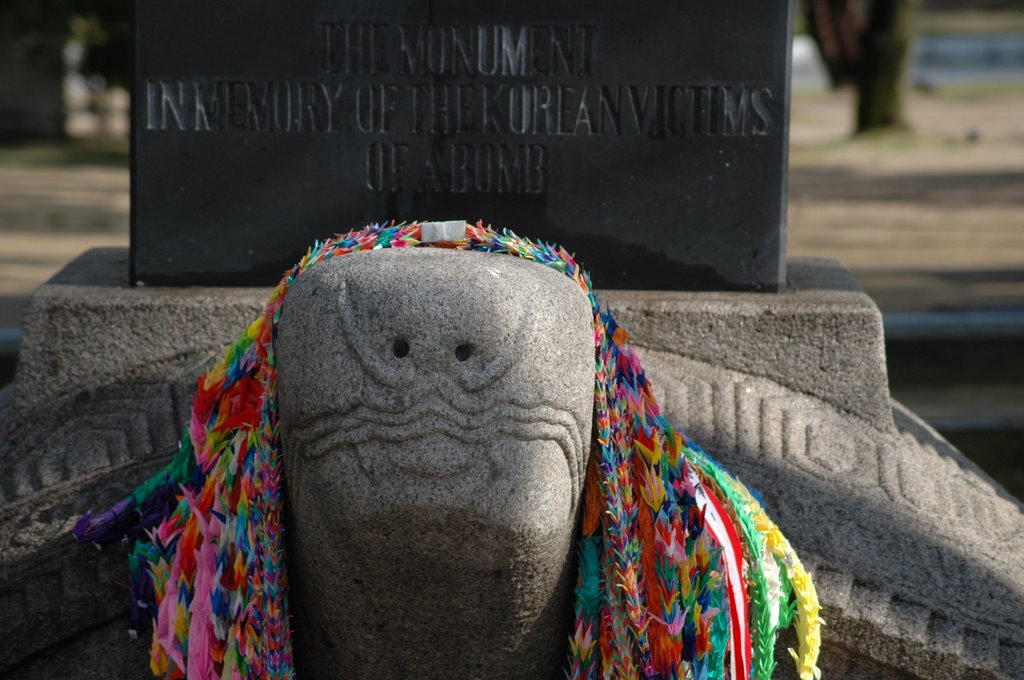 20,000 Koreans were killed on August 6, 1945 in Hiroshima.
 Off the coast of Hiroshima, on the island of Miyajima. The Torii of Itsukushima Shrine.

Thursday, January 18, 2007
A Yellow Sea Winter's Day
A Sunday and snowing in Jeonju. Woke up with a longing for the sea. So I walked to the bus station and, not knowing anything about so-called "good places to go" I chose a name from the map on the wall. Gyeok-po. The name of a tiny red dot straight west of here and on the edge of the peninsula.
On the drive out, from the bus window I could see the blue and green layered tiles of the ancient building rooftops. The farther from town I went the more space opened up--into ginseng and rice fields, mountains in the distance, ginkgo biloba and pine trees--and with less city came more blue sky and cleaner air. For the first time since coming to Korea I could see into the distance and it made my soul open up and unfold. I could breathe again.
Korea has an ancient past. To know this one only needs look into the country hillsides where the open spaces that cannot be tilled for farming are covered with mounds the size of a Volkswagen Beetle cab. The mounds are covered in grass and usually accompanied by a marker-flag with Chinese script. They prevent people from walking over the coffins underneath. The hills are covered with these graves like a case of the hives.
An hour and a half later the bus drove along the cliffs at the western edge of the country, where Korea meets the Yellow Sea. The shoreline there is calm, the sea is a sliver between China and Korea, but the waves still lick the rocks and cliffs and carve away the earth. The sea is the northern part of the China Sea, but the Koreans refuse to call it that--instead choosing to name it after the yellow sand that colors the water.
The bus stopped in town and let me off. After negotiations with the bus driver for a ticket home at the end of the afternoon, it was off to find a beach to drink the bottle of wine I carried with me. I walked past seafood restaurants with caught creatures swimming in tanks, a carnival with a shutdown Ferris Wheel and everything else stopped, everything around empty and dead and stopped. Live in Korea long enough and you'll know how rare it is to walk a city block and not see another person.
Once through the town, a bay with a long pier extended into a white lighthouse. Ships anchored in the bay--none coming, none going. It was starting to snow harder now, the flakes big and wet sticking in my beard. Walking out on the pier, toward the lighthouse, I passed tents lining the walkway on my right. At least a dozen, and they all had orange, plastic traps for roofs. Inside, arranged in pairs, one tarp covered bucks of sea creatures: octopus (live), squid, sea slugs, clams, oysters, mussels, sea cucumbers, shrimp, lobster, crabs, and other creatures I cannot name. They floated in the bucket water. The next tent covered a long, short table with a grill in the center and cushions to sit on cross-legged on the floor. The way it worked, you would point into the buckets, tell the man what and how many, and he would slice the sea animal into chunks and take it to your table, where you waited with chopsticks at the ready to cook, then eat, the creature.
I wasn't hungry. So I kept walking to the end of the pier, to the towering white lighthouse. Once there, I could look out to an island that loomed gray and fog-covered in the distance. The gray sky and snow-laden clouds prevented me from seeing beyond it, farther, to China.
Wet snow drove me back, for shelter. I found it in a cliff the Koreans call "The Library." The rock formation looked similar to books stacked upon one another, with the striations, the lined markings, creating a sense of thousands of pages. Legend told of a Chinese prince who drowned in the waters there, drunk, leaving his boat to swim after the moon's shadow reflected in the water. The overhang of the cliff blocked the snow. I sat on a stack of the collected works of Vladimir Nabokov and watched the waves crash and spray over the rocks at my feet. Out on the horizon, the clouds and fog were gradually lifting and, behind the first island, another began to reveal itself. It was as though I was moving to them--or they were coming for me. I took out my pocketknife and the wine and drank from the bottle. I watched as more islands came closer.
The snow stopped. The sky colored as the sun went west to light the rest of Asia. Then it was far too cold to stay on the cliff and I found my way to a restaurant for coffee and bibimbap. After dinner, the bus ride home was quiet and dark. The moon followed, smiling.
On the drive out, from the bus window I could see the blue and green layered tiles of the ancient building rooftops. The farther from town I went the more space opened up--into ginseng and rice fields, mountains in the distance, ginkgo biloba and pine trees--and with less city came more blue sky and cleaner air. For the first time since coming to Korea I could see into the distance and it made my soul open up and unfold. I could breathe again.
Korea has an ancient past. To know this one only needs look into the country hillsides where the open spaces that cannot be tilled for farming are covered with mounds the size of a Volkswagen Beetle cab. The mounds are covered in grass and usually accompanied by a marker-flag with Chinese script. They prevent people from walking over the coffins underneath. The hills are covered with these graves like a case of the hives.
An hour and a half later the bus drove along the cliffs at the western edge of the country, where Korea meets the Yellow Sea. The shoreline there is calm, the sea is a sliver between China and Korea, but the waves still lick the rocks and cliffs and carve away the earth. The sea is the northern part of the China Sea, but the Koreans refuse to call it that--instead choosing to name it after the yellow sand that colors the water.
The bus stopped in town and let me off. After negotiations with the bus driver for a ticket home at the end of the afternoon, it was off to find a beach to drink the bottle of wine I carried with me. I walked past seafood restaurants with caught creatures swimming in tanks, a carnival with a shutdown Ferris Wheel and everything else stopped, everything around empty and dead and stopped. Live in Korea long enough and you'll know how rare it is to walk a city block and not see another person.
Once through the town, a bay with a long pier extended into a white lighthouse. Ships anchored in the bay--none coming, none going. It was starting to snow harder now, the flakes big and wet sticking in my beard. Walking out on the pier, toward the lighthouse, I passed tents lining the walkway on my right. At least a dozen, and they all had orange, plastic traps for roofs. Inside, arranged in pairs, one tarp covered bucks of sea creatures: octopus (live), squid, sea slugs, clams, oysters, mussels, sea cucumbers, shrimp, lobster, crabs, and other creatures I cannot name. They floated in the bucket water. The next tent covered a long, short table with a grill in the center and cushions to sit on cross-legged on the floor. The way it worked, you would point into the buckets, tell the man what and how many, and he would slice the sea animal into chunks and take it to your table, where you waited with chopsticks at the ready to cook, then eat, the creature.
I wasn't hungry. So I kept walking to the end of the pier, to the towering white lighthouse. Once there, I could look out to an island that loomed gray and fog-covered in the distance. The gray sky and snow-laden clouds prevented me from seeing beyond it, farther, to China.
Wet snow drove me back, for shelter. I found it in a cliff the Koreans call "The Library." The rock formation looked similar to books stacked upon one another, with the striations, the lined markings, creating a sense of thousands of pages. Legend told of a Chinese prince who drowned in the waters there, drunk, leaving his boat to swim after the moon's shadow reflected in the water. The overhang of the cliff blocked the snow. I sat on a stack of the collected works of Vladimir Nabokov and watched the waves crash and spray over the rocks at my feet. Out on the horizon, the clouds and fog were gradually lifting and, behind the first island, another began to reveal itself. It was as though I was moving to them--or they were coming for me. I took out my pocketknife and the wine and drank from the bottle. I watched as more islands came closer.
The snow stopped. The sky colored as the sun went west to light the rest of Asia. Then it was far too cold to stay on the cliff and I found my way to a restaurant for coffee and bibimbap. After dinner, the bus ride home was quiet and dark. The moon followed, smiling.
Friday, January 05, 2007
What teaching teaches me
This comes at the end of my second month in South Korea
In my last longer piece I talked about a few snapshots in my daily life as a teacher in Jeonju,
I discussed taxi-drivers, surface level observations, and my interactions with other foreigners from all over the world.
This time I’ll try to describe my initial impressions as a teacher.
That said, I realize my observations come after a mere two months on the job and are in no way complete. Still, here goes.
First, a rundown of my job:
I teach four classes. In the morning I teach ten kindergartners, boys and girls, age 7.
In the afternoon it’s elementary and middle school children.
I have one class of four 9-year-old boys, one of five 10-and 11-year-old boys and girls, and one of eight 11 to 13-year-olds, all boys except for one.
The students are good—for the most part. Of course there’s always a clown. Or a nerd. Or a donkey.
I don’t necessarily think of any particular child in this sense. But these are traditional societal roles and they have to be filled—even at age 7.
When I started working with the children, one of the first observations I made I passed on to a fellow teacher who has been doing this for going on three years.
“Being a teacher really makes it hard to argue against evolution,” I said. “The case is made for natural selection almost constantly.”
“Or made against it,” he replied. “You wonder how some of these kids have made it this far in life.”
From a social science perspective, it’s difficult to determine, to pinpoint, what is more important for a child’s success in school—her genetics or the guidance she receives from her parents.
Inside the classroom, however, and I’ve spoken with other teachers about this and we agree, the most important and beneficial trait a child can possess is a good attitude.
Natural intelligence factors in, as does parental pressure and emphasis on work and discipline. But when it comes to the classroom and what a child gets out of their time sitting in front of teachers, a willingness to learn and a good attitude about school make a significant difference.
(Yes, I realize what my high school teachers are thinking when they’re reading this—that they can think of a pretty good example of someone with potential but a misplaced attitude toward education. His mug shot’s looking right at you.)
My job teaches me so much about myself. I have some students that I can tell devoutly despise school. They don’t like being there even though they’re completely capable of doing the work.
I see myself in that. I had many school days—practically every day after the start of the fifth grade—where I thought to myself there was something I’d rather be doing.
Recognizing the same sentiment in my students helps. I don’t pander to that behavior just because it’s familiar, but when I do see it I avoid becoming frustrated or taking it personally.
Which in turn lessens the pressure on the student and, though I still maintain behavior standards, I have gotten good responses.
I know. It sucks sometimes. Just do it right and do it now and you’ll be better off.
I see myself in those students.
I see myself in all my students. As a child going through kindergarten, as a young student who knew a lot of the answers and always raised his hand, as a good student until being a good student became less important than being cool.
It’s one of the most rewarding things about this job. I love my students. Some more than others, but even those I love less I learn from.
Like them, I’m learning every day.
Sunday, December 17, 2006
Annyahasayo is Korean for hello
 Jeonju
I left home a month ago.
At the beginning of November I left Scottsbluff to begin a job as an English teacher in
Since March 2005 I have lived on a 180 acre farm 9 miles east of Scottsbluff—my closest neighbor one-fourth of a mile away.
Now I live in a city where the first sights of the morning, through my studio apartment window, are power lines and the tops of shorter buildings.
Out the front door of my building, across the street, is a 20-plus story apartment building that occupies most of the block. Which (though to this Nebraskan it seems quite large) is a common structure in my surroundings. I pass many buildings of the same size or larger on my way to work.
***
The stories have already started to build.
Two weeks ago, on the way home in a taxi, the Korean driver asked me where I was from.
I told him, he responded with, “I love
He then proceeded to belt out a few verses of a song in Korean-English, blurred Ls and Rs, that I couldn’t quite recognize.
“Now you,” he said. “Sing
He turned the radio down. I politely declined.
He persisted.
“Sing
So, being the reluctant patriot I am, and because in the context of the scene I couldn’t think of a more fitting song, I went for it.
“I was…Booooorrnn in the
He sang along as well, though his words and mine were decidedly different.
***
Koreans are flatterers. They compliment people on their appearance whether you deserve it or not.
They’re quick to throw out a “handsome,” or “movie star.” I’ve even heard Robinson Crusoe and Jesus Christ directed this way.
Every day is unique. I learn something about myself and about their culture on a daily basis.
A friend gave me a Moleskin notebook that I carry with me. In it I make notes such as:
I sit in a park. The sun is out through the smog and I can smell sesame oil cooking in a restaurant down the street. The people here are kind if not overly friendly. There are so many of them in such a small space they do not waste time on strangers.
***
Another interesting aspect of life in
The Canadians have been the toughest to become acquainted with. I’ve had more arguments than agreements with the Canucks to this point.
It’s generally agreed upon that they have chips on their shoulders about their neighbors to the south.
Many have been living in
Some people here claim they have a “small man’s complex.”
To return their feeble attempts at derision, there’s a line from the Simpsons that my American friends and I fall back on.
In the episode “The Bart Wants What It Wants” Homer and the family are faced with a trip to
Homer responds with “
***
As with anything, it’s a mistake to rush to judgments. I purposefully refused to think ahead too much about this experience. That has paid off. I’m constantly surprised by this culture. In the similarities, in the subtle differences, and in how much it’s teaching me about myself.
Saturday, December 16, 2006
Manifesto
Honesty and accuracy do not always run concurrent. Initial reactions can be true as the gospel, but after time elapses and more scrutiny is applied, those impulsive judgments often expose themselves as rash and inaccurate. In recognizing this, it is the purpose of Korean Folk Songs to deal in both surface-level observations and deeper understanding of Korean culture. Though the first will open up doors to contradiction, shallow fallacy, and further-down-the-road hypocrisy, these facets and by-products of observation are essential for the aforementioned understanding to occur. I am not afraid of being wrong, but terrified of ignorance.
Subscribe to:
Posts (Atom)


 Posts
Posts


