Thursday, October 02, 2008

Cities in rivers, Oregon Trail, end of summer, and Hymn California


One of my great favorite writers is also one of my great favorite friends. He wrote a book that got published this year, and it's Henry Miller and Jack Kerouac, but today. It's stories about America from a guy that's done more living in 30-some years than three people do in their lives. Raw, vivid, lyric descriptions--sung stories about fighting through hard times in hard places.
Hymn California’s characters witness a strange wide-sweeping, panoramic America unfolding before them, while its 200 pages examine death obsessions, regional history, difficult love, and having an abusive relationship with a place (California) rather than a person. It shows displaced characters scattered across the continent, burdened by fear and homesickness while fighting to have a good time, raise hell, and live unencumbered by bourgeois ideology and “bullshit consumer culture.” Death stalks at every intersection and on every riverbank. Lives sway in the delirium of wartime. Waffle Houses, UFO cults, dead friends, serial killers, yellow-lit billboards, reluctant soldiers, suicidal teenagers, drug dealers, grandparents, Mexican cops, drunken cat-killers, and the Pope collide like trains. As its road story unravels, the characters find heavy violence, superstition, hard drugs, and surreal and wonderful mornings set across the contidental US and Mexico. Says Gnade, “a friend of mine asked me if I was trying to write ‘American magic realism’ with the book and I didn’t really have an answer for him. If it is, it was an accident.”
He lives in Portland, Oregon, and if you do too you can buy the book at Powell's Bookstore. If you don't, you can order it here.

Wednesday, October 01, 2008

5 podcasts

1. NPR: World Story of the Day Podcast

Hard news from around the world. Short, usually 3-4 minutes.

2. The FADER

Street-level music magazine set lists. If I had a house, I would have a party every month when these come out and all my friends would think I had excellent taste in music.

3. Rocketboom

Smart, breakneck 3-minute videos on internet culture. I have a huge crush on the host, Joanne Colan, who is often funny, always attractive.

4. Slate Magazine Daily Podcasts

Insightful commentary on the world. News stories everyday are relevant and sharp. My favorite part is the Gabfest, where three whip smart journalists hash out the week's news and give recommendations for party chatter.

5. This American Life

Great stories.

6. New Yorker: Comment

Analysis about America from the best writers in America.

7. APM: Weekend America Enhanced Podcast

Stories about America that remind me why I miss it. John Moe is hilarious. Last week he told the joke: "What is brown and sticky? A stick."

Find all these by searching the titles in iTunes.

Someone great in Seoul?

LCD Soundsystem is playing a disco set in Seoul on Oct. 10. Maybe. I don't trust Korean promoters, especially whenever it sounds too good to be true, as this does. I'm trying to do a story on it for the Herald for next Thursday's paper. We'll see. If it does go down, I'll be there with my disco boots and gold chain, and you should too.

Mix Tape #1

If I would make you a mix CD right now, I'd make you two, and this is what I'd put on them.

Disc 1
1. "People As Places As People"-- Modest Mouse
2. "Call It A Ritual"-- Wolf Parade
3. "You Belong"-- Hercules and Love Affair
4. "Let's Make Love and Listen To Death From Above"-- CSS
6. "No Substitute Love"-- Estelle
7. "First Class Riot"-- The Tough Alliance
8. "50 Ways to Leave Your Lover"-- Paul Simon
9. "Lost Coastlines"-- Okkervil River
10. "Love Dog"-- TV On the Radio
11. "Visions of Johanna"-- Bob Dylan
12. "Skinny Love"-- Bon Iver
13. "Twilight"-- Elliott Smith
14. "Waiting Around to Die"-- Townes Van Zandt

Disc 2
1. "Four Provinces"-- The Walkmen
2. "Constructive Summer"-- The Hold Steady
3. "You Don't Know What Love Is (You Just Do As Your Told)-- The White Stripes
4. "Gobbledigook"-- Sigur Ros
5. "Party Barge"-- The Silver Jews
6. "I Luv the Valley OH"-- Xiu Xiu
7. "Where Summer Goes"-- Peter and the Wolf
8. "Fools"-- The Dodos
9. "Rise Above"-- The Dirty Projectors
10. "Little Brother"-- Grizzly Bear
11. "Lawyers, Guns, and Money"-- Warren Zevon
12. "Sympathy For the Devil"-- The Rolling Stones
13. "If I Had a Boat"-- Lyle Lovett
14. "Green Gloves"-- The National

Ways of Seeing

For the duration of this blog, nearly two years, I have been posting longish pieces written for newspapers in Nebraska and Korea. I have since decided to take a slightly different approach. It won't always be about Korea -- in fact it probably won't be that much about Korea at all, aside from the obvious fact that I live in Seoul and that will underscore my writings. I'll still post stories I write for the Herald and elsewhere, but I'll try to keep my posts brief and more frequent. As always, comments, feedback, etc. are encouraged.

--Bart

Thursday, August 28, 2008

5 Pictures of Bukhansan


Thursday, August 14, 2008

Marilyn Manson, Death Cab For Cutie and Korea's Michael Jackson


Sometimes referred to as “the president of culture,” Seo Taiji is one of Korea’s biggest cultural icons.


The first time Marilyn Manson played in Seoul his band destroyed the venue’s sound system because their music was turned up too loud.


American rock band Death Cab for Cutie weren’t used to the kind of media attention they received when they shared the press conference with Seo Taiji.

5 Pictures of Maisan


Tuesday, August 05, 2008

You don’t understand Korean culture

"I think foreigners do have a right to speak about problems in Korea and to address sensitive issues from our own perspectives. At the most basic level we are invested in this society, even if for only a short time, and we pay taxes, function as consumers, participate in local communities, and teach local children." --Brian Deutsch


In 2007 and 2008, in a span of 12 months, seven school children from Jeollanamdo died in traffic accidents. Suncheon-based teacher Brian Deutsch found it interesting how educators mobilized their students to protest American beef imports, but said little about traffic safety. So he wrote an opinion piece for The Korea Times titled “Rallies Have Little to Do with Food Safety.”

In the piece Deutsch, who is American, wrote: “Encouraging students to skip school to attend these candlelight vigils and rallies is not only inappropriate and outside the bounds of a teacher-student relationship, but it detracts attention from more pressing issues students are facing.

“Namely, they are far more likely to be killed on field trips or while walking home from school than by contracting mad cow disease, which as of yet has claimed no Korean or Korean-American lives.”

Add that to a previous piece about the use of Nazi imagery in a skin care ad, both of which were used in a modified version for the Gwangju News magazine, and Deutsch had attracted the attention of the netizens.


Who told you to talk, foreigner?


The internet campaign was led by a Gwangju man Kim Hong-su. He started two blogs to counter Deutsch’s stories and posted Deutsch’s name, blog url, and Facebook profile on Daum cafes along with an accompanying letter. He also posted the names of Deutsch’s schools and advised people to direct their complaints there. Deutsch went to the police but was told they were too busy.

Kim wrote: “What galls me the most is that these foreigners are growing fat and rich in Korea teaching their native tongue while making fun of the same people who are paying their wages. I need your (other Koreans') help in correcting this kind of behaviors from foreigners. I would like you to e-mail the editor and those of you who are local to Suncheon should track down this Brian Deutsche (sic) and find out which school or hagwon he teaches in. You can assist me when you find that information. I seek full and unfettered cooperation in my campaign to correct this foreigner's behavior. If we cannot do that to a foreigner on our own soil, how can we hope to correct the behavior of U.S. President Bush?”

I emailed questions to Kim concerning Deutsch. He responded with, “Before you try to learn about Korea via a Korean, you should learn Korean and ask the questions in Korean first.”

The Gwangju News is operated by the Gwangju International Center. When Deutsch consulted with the staff at the GIC, they told him they didn’t like his articles, either. They didn’t like the Nazi story or the traffic safety story, and they also didn’t like the story he wrote about the drowning death of a 14-year-old American boy, Michael White.

The staffers told him the magazine was publishing stories that were too foreigner-intensive. On top of that, the publisher of the magazine told Deutsch that they might as well close down the magazine if it wasn’t going to be appreciated by foreigners.

Deutsch quit the magazine. But his troubles weren’t over.


'Generalizations are kind of fun'


Anyone can be a blogger. It takes minutes to sign-on to Blogger or Wordpress. Throw up a few pictures, spew some vitriol and start checking the site meter for hits. Living overseas it’s a good way to stay in touch with friends and family. The days of the mass email are over—check the blog for life-updates.

It’s common for teachers and other non-Koreans to start up a blog. But most of them die a slow death. It’s difficult to update often enough to keep readers; what seemed like a good idea at the time can easily turn into a bore.

Still, there a few prominent expatriate blogs in Korea that receive a lot of hits. The six we are interested in here are: The Marmot’s Hole, Scribblings of the Metropolitician, The Grand Narrative, Ask a Korean! Roboseyo and Deutsch’s – Brian in Jeollanam-do.

The Marmot’s Hole is run by Robert Koehler. It is the most heavily trafficked blog of the foreigner-in-Korea set. Koehler, with the help of a handful of guest bloggers, posts news items, analysis, entertainment and pictures of old buildings. Koehler is American, the editor-in-chief of SEOUL magazine, and has been operating the blog for five years.

“Our role is to offer commentary and criticism from a fresh, outside perspective,” Koehler said. “That being said, it’s easy to overthink these things – personally, I don’t think the ‘foreign observer’ has any special role beyond that of any observer, which is to say, relaying observations he or she has made.”

“All countries are open for criticism. The question that really needs to be asked is whether anyone should take what we write seriously. For the most part, the answer to that would be no.

“Most of us are guys with too much time on our hands who like to bitch about things we don’t really understand. Which, granted, would make our uneducated rants little different from much of what passes for commentary on Korea, Western or Korean.

“I have a warning on my blog asking readers not to generalize from anything they read on my site, but still, many seem to do it anyway. Besides, generalizations are kind of fun -- nationalistically hysterical Koreans, pot-smoking over-sexed English teachers, condescending expats … who doesn’t love ‘em? It’s all a question of how seriously you take what you read.”


Do you see what I see?


Scribblings of the Metropolitician comes from Michael Hurt. The blog is a mishmash of social criticism, international politics, pop culture and comments on Korean media. Hurt first came to Korea from America as a Fulbright English teaching assistant in 1994. After earning his master’s in ethnic studies from the University of California-Berkeley, he came back in 2002 to finish his dissertation research on Korean nationalism. Now in his eighth year in Korea, he edits the Korea Journal and teaches social issues in Korea at Honguk University.

Both Koehler and Hurt brought up Alexis de Tocqueville. De Tocqueville was a 19th century Frenchman who wrote “Democracy in America,” considered by both men to be a great book about America.

“The fact that we’re foreigners shouldn’t disqualify us. I look at American social commentary and social criticism and some of our sharpest and best social critics have been foreigners, people coming from a foreign perspective,” Hurt said.

“We have eyes, we have ears. We can read your newspapers. We read what you read. We have access to your information.

“I pay taxes, I buy (things) I live here, so why do I have any less say than you do?

“Why would I put all this effort, why would I even care, or put myself out there, why would I do this if I didn’t actually give a shit?”


We’re not that different


New Zealander James Turnbull runs The Grand Narrative. He calls it “An irreverent look at social issues.” Much of his work deals with Korean advertising and media as well as social commentary. In his eighth year in Korea, Turnbull teaches English in Busan.

“I find the notion that only Koreans are ‘permitted’ to speak about Korean problems simply absurd. That isn’t to say that all foreigners’ opinions on them are equally valid, but if the roles were reversed then I’d be quite happy to hear the opinions of, say, a Korean person who had spent some time in New Zealand and who made an active effort to study and know New Zealand society and learn the language. In fact, probably more so than someone who was merely born there.

“The majority of netizens aside, I’ve actually found a significant number of Koreans to feel much the same way about the opinions of non-Koreans.

“Koreans are not unique in readily dismissing the opinions of foreigners, but they do seem more defensive about foreign criticism than most. For that reason, it is very important to use Korean sources as much as possible.

“Another advantage to using and considering Korean-language sources as much as possible is that it makes you realize how much you may stereotype and generalize Koreans yourself without being aware of it.

“Without any Korean ability, foreigners are usually forced to rely on either the limited English language media or books for the bulk of their information, and both have problems: the former for often presenting a rose-tinted version of Korea to the world, and the latter for being quickly out of date in a country as rapidly changing as Korea.”

Koehler also emphasized using the native tongue.

"Do it in Korean, and in a major Korean newspaper," Koehler said.

Writing complaints in English may be "cathartic," he said, but it does no good.


Why do foreigners complain so much?


Another pair of bloggers, a Korean man living in America (Ask a Korean!) and a Canadian teacher in Seoul (Roboseyo) put together a two-part series dealing with foreigner criticism and social commentary.

Ask a Korean! wrote, “many complaints from expats that the Korean has seen show a certain level of ignorance. This is not to say that complaining expats are dumb. It is only to say that were they more aware of certain things about themselves and about Korea, they would not be complaining as much, and the pitch of their complaints would not be as strident.

“Expats rarely venture out of large cities in Korea, and they only really interact with Koreans who are fluent in English. Do you know what makes a Korean fluent in English? Money, tons and tons of it. So not only are expats insulated from older Koreans, they are also insulated from younger Koreans who are poorer. What kind of understanding about Korea could an expat possibly have with this kind of limited exposure?”

About social critics, Roboseyo wrote, “Naming a problem is the first step to solving it, and maybe some of these critics are attempting to be a legitimate part of that process -- that is, they're writing because they want to see Korea become a better place . . . in which case, Koreans who are upset about non-Koreans criticizing Korea need to stop and take a careful look at why that upsets them, because the problem does not lie in the complainers or their intentions.

“To be fair, sometimes the social critics' intentions are good, but their methods are poor: the sometimes bitter and mean tone of certain critics can be hurtful, and as I've said to some of my friends who complain about Korea with a rude or condescending tone: "when you talk so harshly, even when you're right, you're wrong, and even if you win the argument, you still lose."


You don’t understand Korean culture


Deutsch plans to continue writing for the Korea Times and updating his blog.

“I like doing it and I like staying on top of current events and discussions. On the one hand I totally recognize that I’m being paid to teach, not to think, and I say that without being cynical at all. Most people couldn’t care less about the particular issues foreigners face, whether in the classroom or in society at large, and hearing a foreigner talk about them probably isn’t very interesting.

“I’ve also had to question how welcome those opinions are. My colleagues themselves told me that it was not my place to opine on what are called ‘sensitive issues,’ and a recent letter to the editor in the Gwangju News suggested that I, and foreigners, mind their own business and not worry about Korean internal affairs.

“But I think foreigners do have a right to speak about problems in Korea and to address sensitive issues from our own perspectives. At the most basic level we are invested in this society, even if for only a short time, and we pay taxes, function as consumers, participate in local communities, and teach local children.

“Moreover these issues are so prickly because they’re not black and white. While it might be unpleasant for some Koreans to hear the other side of the story, I don’t think it’s inappropriate for it to be raised.

“Our opinions are often dismissed with a line about ‘you don’t understand Korean culture.’ Often this comes when something unpleasant happens to a foreigner, or when a foreigner expresses an opinion disagreeable to the Korean listener. It’s well beyond my abilities to explain why this happens, but it’s patronizing and inappropriate. I do believe that although foreigners can sometimes dwell on the negative when writing or talking about Korea, I think taking a critical look shows an interest in the host culture that can be healthy if applied properly.

“I realize that a greater measure of tact is necessary when addressing sensitive issues and when trying to foster conversations across cultural boundaries, but even with a lot of coddling I remain cynical that people are ready to hear what we have to say just yet.

“I would love to have Koreans who disagree with me take the time to point out their objections, rather than simply railing against a foreigner who dares to publish something against the grain. And I would love to have Koreans spend more time trying to educate us about their culture and their views, then, since so much energy is spent telling us how wrong and misinformed our opinions are.”

Deutsch was asked by his school to drop the case against Kim. His job was also placed in jeopardy because of what he has written.

Wednesday, July 30, 2008

Stomp your glasses, get eye surgery

My eyes went bad early. For most people, it’s the changing shape of our eyes that makes our vision worsen as we age, and mine started changing in elementary school. The correction was slight enough that I could do most things without wearing my glasses. But the older I got the more I had to wear them.

When the doctor prescribed contacts at age 14 I thought I was saved. Glasses at night only. No more straps around my neck on the basketball court. No more four-eyes comments on the playground.

I loved my contacts. I loved them too much. By the time I came to Korea the contacts had sucked out all the moisture in my eyes. Add that to the air quality, particularly during Yellow Dust season, and I abandoned them completely.

So I was back to full-time spectacles. My optometrist brother hooked me up with good, fashionable frames for cheap. They looked good enough, fit right, and I hated them. Wearing glasses distanced me from my environment. They made me feel less engaged somehow, less part of my surroundings -- more of an observer than a participant.

Eye surgery is not a revolutionary idea, I realize. But, for me, a person who has always had a strong aversion to doctors and operations, it meant something that I would willingly pay to have a doctor slice my eyes with lasers.

I have a great Korean friend who is also a doctor. For the initial tests, he took me to a clinic recommended by mutual friends. During the evaluation, the technician put in anesthetic eye drops and pressed against my cornea with a handheld tool. I asked him if he was touching my eye. Then the room got hot. The problem came from what I couldn’t feel; I knew he was touching the surface of my eye but I registered no sensation. My blood pressure dropped. I went pale. Droplets of sweat formed on my brow. I put my head in my hands, focused on my breathing, and fought off a feint.

Glasses, I told myself. It’s either this or endless glasses.

I took a few more breaths, sat up, and told him to finish.

After the tests the doctor told me I had thin corneas and would need Lasek, not the more common Lasik, surgery. Clinics here offer Lasik, but Lasek is also used. Lasek is a variation of Lasik. In Lasek the outer layer of the cornea is cut with a finer blade. Then the surgeon covers the eye with an alcohol solution for around 30 seconds. The solution loosens the edges of the epithelium. After sponging the alcohol solution from the eye, the surgeon uses a tiny hoe to lift the edge of the epithelial flap and gently fold it back out of the way. Then out comes the laser to sculpt the corneal tissue underneath. Afterward, the epithelial flap is placed back on the eye with a kind of spatula.

I made an appointment for a month later. Then I went home and thought it over. I loathe going to doctors, but if I could see without any aid! It would cost 2 million won ($1,900), which was a good amount of money. But considering that I spent hundreds of dollars each year on eye care -- glasses, contacts and contact solution -- the surgery would pay for itself in less than 10 years.

The morning of the surgery I asked myself if I couldn’t handle the simple preliminary tests, how could I make it through the procedure?

Glasses, I told myself. And Xanax. I made sure my friend brought plenty of Xanax.

I went into the clinic and they had me go upstairs. Most of this was in Korean, which I don’t speak, and only the essential parts were translated to me. There was a lot of sitting around confused. Then somehow I found myself staring down a phlebotomist. I do worse with blood than technicians prodding my eyes (feinted at the blood bank in 7th grade, went pale multiple times in high school biology.) After the translation the Vampire said he needed my blood to make serum for eye drops. It would help my eyes heal faster, he said.

He took out a strap, wrapped it around my arm, and drew out seven vials of blood. At about the sixth vial my blood pressure dropped again.

Glasses. Do you want to wear glasses? Do you?

Now the only thing left was the lasers. Before the surgery my brother had told me Lasek was a good option for my prescription. But he also said it wasn’t a common procedure in America. Patients find it too painful.

I was trying not to think about that when I lay down on the operating table. They kept the room cold. The doctor had a good, calm manner about him. He and his nurses administered anesthetic eye drops, a device to keep my eyes from blinking, and began the procedure. I looked up, down, and at the green light as per the doctor’s orders. In 20 minutes it was over.

I stood up and walked out of the room, smiling with relief, my eyes barely open but I could still see.

We stopped at the pharmacy and then my friend drove me to his house. The protective contacts made my eyes uncomfortable but I had eye drops for that. In fact, I had five bottles of drops, one made from my own blood. They gave me no additional pain medicine.

When I got to my friend’s home I took a pill and fell asleep. I incorrectly thought I’d wake up healing; hours later I sat up moaning, in severe pain. Nothing I had ever put in my eyes, not soap, not sand, not the wrong contact solution -- nothing had ever caused me more optic pain. I sat up and took two Tylenol ERs and put in the anesthetic eye drops. That didn’t dent it. I woke up my friend and like a good doctor he snapped into action, shooting me with a syringe full of painkillers. That did it.

That moment was the worst of it. I was back at work in five days and in a week I had nearly perfect vision. Two weeks later friends tell me my eyes look brighter. They do. And I already forgot where I banished my glasses.

Saturday, July 26, 2008

Five pictures of Udo


Tuesday, July 22, 2008

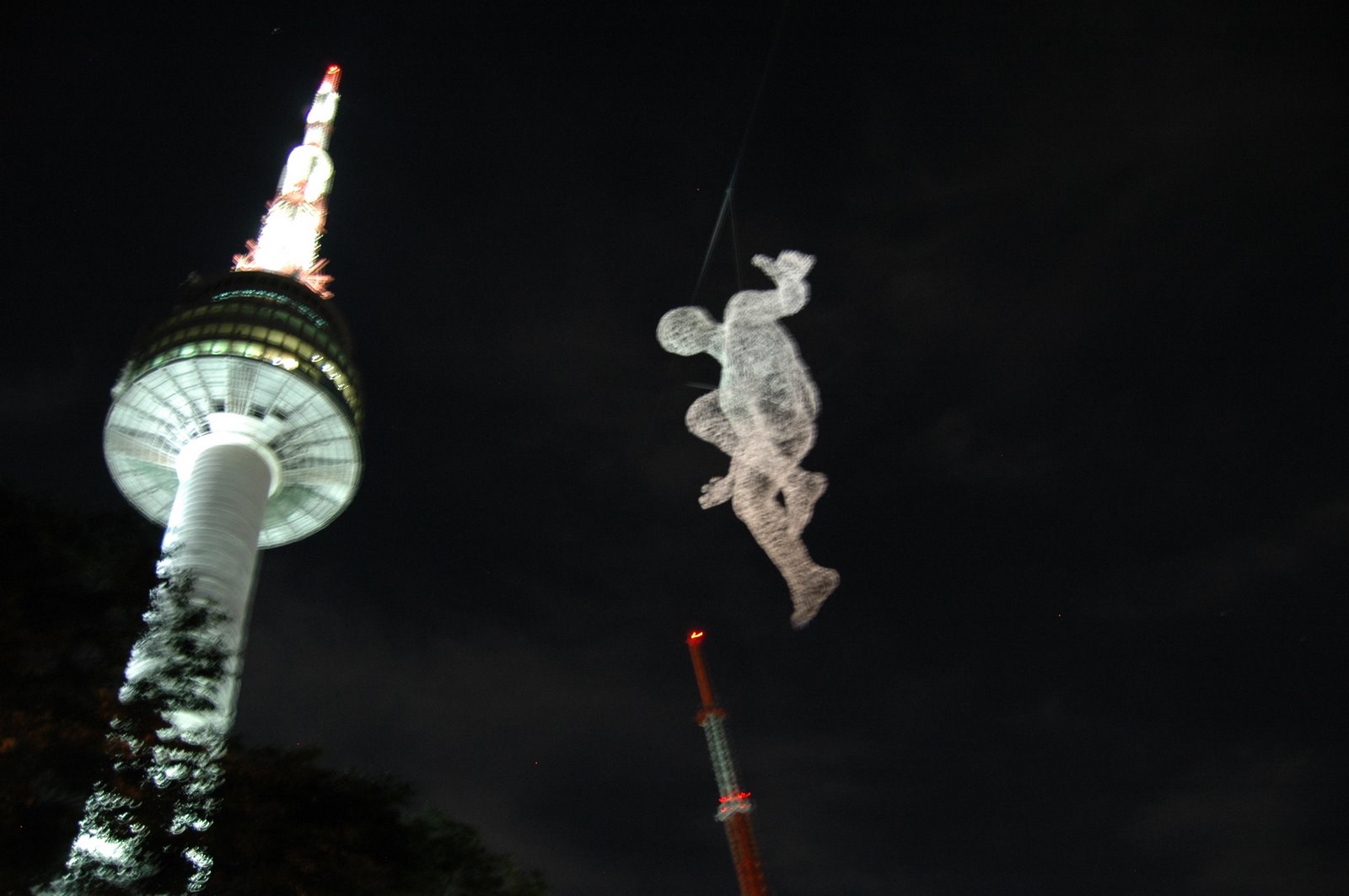
Wolmido and Night Shots from Namsan Tower


Saturday, July 19, 2008

Gates and Alleys (Jeonju)


Friday, July 18, 2008

Beat the Heat with Dog Meat, or Dogs are Not Delicious


When it’s hot outside nothing cools you down like a bowl of dog stew.
On one of the hottest days of the year I checked my phone. I had a text message:

HAVING DOG SOUP IN HONGDAE IF U KEEN

ARE YOU KIDDING?

NOPE…YOU KNOW…WHEN IN KOREA…

For years locals have enjoyed summertime Bosintang. Bosintang literally translates to “invigorating soup” -- one of many foods known as Good For Man. According to Koreans, what’s good for man is dog meat boiled with soy paste, green onion, leek, stalk of taro and red pepper.

The soup is traditionally eaten on the hottest days of the year. As with the chicken soup samgyetang, Koreans believe eating the hot food when the outside temperature rises makes the heat less noticeable.

With the heat index over 40, I met eight friends -- two Korean, six from places where people eat questionable meat but not dog -- at exit #2 of Hongdae Station.
Our group was quiet as we walked up the street. We walked slow, barely talking, looking at our feet. A few people made bad dog puns. We were travelers, adventurers -- of those who often said “I’ll try anything once.” Now we were forced to prove it and it felt grim, like being caged.

On the sign out front a smiling woman held a large, white cartoon bone.
Typically you would see a cartoon drawing of the animal you’re about to eat. I half expected to see a fattened Goofy. But since the negative international attention Korea got for dog cuisine during the 1988 Seoul Olympics they have hidden their love of dog. Korea banned dog meat during the Games by invoking a law prohibiting the sale of "foods deemed unsightly." After the Olympics, the ban was not strictly enforced.

As we came to the doors of the restaurant somebody said, “Looks a bit dodgy.”


We walked in. The restaurant was empty with the faint smell of wet pooch. We took a table in the back and sat cross-legged on mats.
The Korean man with us ordered dog for eight. (One of the group chickened-out, literally, and ordered samgyetang.)

We waited for the food by sharing stories of the strangest food we had eaten. It was like we were at the zoo -- people talking about kangaroos, crocodiles, testicles, buffalos, cats, etc.


“We’re going to get some soju before this, right?” I asked.


Despite the palpable dread, it was late in the evening and I was hungry. The first batch of meat came on plates in chunks wrapped loosely in steamed kale and seasoned with red pepper.
We ordered beer and soju and I made sure I had a shot before we started.

I used my chopsticks to pick up a piece of meat. It was dark, thick and about three inches long.


“My mom used to run a dog restaurant,” the Korean man said. “I eat this many times.”


Nutritionally, 100 grams of dog meat has 20 grams of fat and 19 grams of protein. The meat is high in iron, phosphorous, niacin and riboflavin.


I put the piece in my mouth and chewed. It was tough and tasted slightly of lamb. I thought about spitting it out, but like a good traveler I swallowed it.
Then I understood how a Third World country would find eating dogs economical -- after I ate a single piece I was no longer hungry.

For the second course, the woman brought out bowls of red, steaming Bosintang. The broth of the soup tasted like other Korean meat stews. But I stayed away from the meat. I ate my rice and that was enough.


The meal cost 14,000 won ($13) and I walked out feeling little cooler than when I walked in.
Now, when I see dogs on the street I don’t think “you’re cute” or “you look ferocious” -- instead, I think “you’re not delicious.”

Sunday, July 06, 2008

Shine Your Candles on North Korea

Anti-demonstration protesters. The woman's sign reads "Shine
Your Candles on North Korea", the man's says "No no demo."


South Koreans continue to turn out in the thousands to protest imports of American beef while 40 kilometers to the north, North Koreans struggle to eat.

On Saturday, about 300 protesters opposed to the on-going anti-Lee Myung Bak candlelight demonstrations rallied at the headwaters of the Cheonggye Stream. At City Hall, about 50,000 people protested U.S. beef imports, in the second-largest demonstration over the past two months.

Eun Joo-Kim, a North Korean who defected to Seoul in 2002, was visibly upset when she spoke about the groups protesting American beef.

“North Koreans don’t have food, and here in South Korea they’re saying ‘which beef is better,’” Kim said.

Riot police divided the counter-protest group from the anti-President Lee Myung Bak protesters. At one point the two groups faced each other, both sides holding up signs. The anti-Lee protesters’ signs read “Lee Myung Back Out” while the counter-protesters’ read “Shine Your Candles On North Korea.” They yelled back and forth but no physical conflict arose.

A week ago, 37,000 tons of wheat arrived in North Korea, the first of 500,000 tons of food aid promised by the United States, according to the World Food Program.

At a stage set up the Cheonggye Stream, a North Korean defector spoke to the crowd about a man he met in prison who cannibalized a woman for lack of food. Next to the stage a big-screen television showed videos of recent protest violence.

The anti-Lee protests have grown increasingly more violent. Videos and photographs of assaults on protesters and police have circulated on the internet.

John Yim, a Korean who recently returned from living in California for six years, said he ate a lot of “galbi,” or barbecued ribs, in America and he misses American beef. He spoke against the economic effect of the protests and violence against the police.

Nick Chiassoa, an American English teacher in Gangwan Province, expressed sympathy for the riot police and disdain for the economic ramifications of the protests.

“(The anti-Lee groups) have a right to protest, but they don’t have a right to cripple the city’s infrastructure,” he said.

Separately, an international non-profit organization operating out of Washington, D.C. marched for human rights in North Korea. The group of about 30 South Koreans, North Koreans, Korean Americans and expatriates, all clad in black, held a mock funeral to “ask the South Korean people to help raise awareness for the sufferings of the North Korean people.”

Adrian Hong, director of the organization, said South Korea’s concerns about beef are valid but that he would rather see them putting their energy into the human rights situation in North Korea.